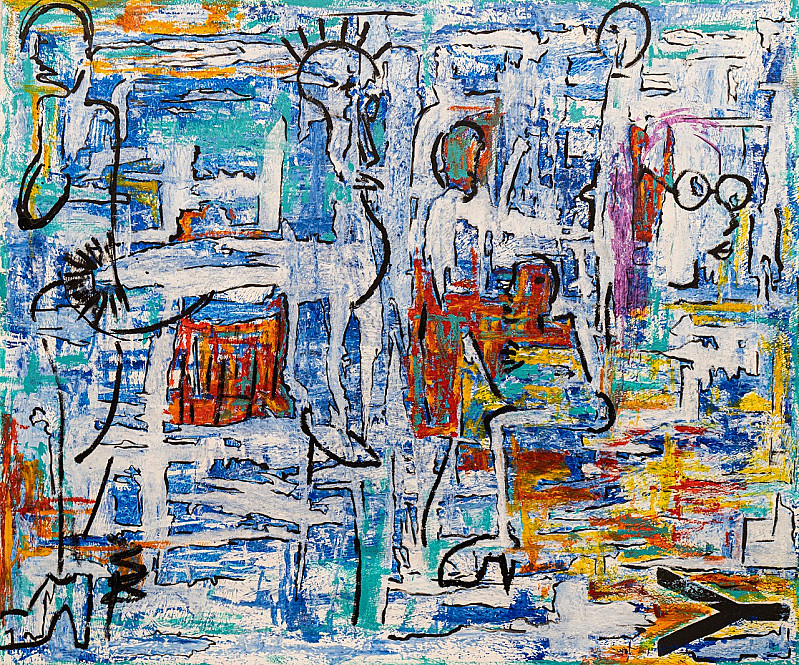
Mazes of Humanity is a collision of movement, memory, and meaning—a visual map with no single route and no final destination. The painting unfolds like a living labyrinth, where faces, symbols, and fragmented forms appear and disappear, forcing the viewer to wander rather than observe. There is no straight path here, only detours, dead ends, and unexpected openings, mirroring the way human lives unfold.
Layers of colour clash and merge, building a sense of congestion and urgency. Each layer feels like a lived experience—choices made, chances missed, identities tried on and shed. The maze becomes a metaphor for society itself: complex, overcrowded, and constantly shifting. We move through systems of culture, belief, trauma, and hope, often unaware of how deeply they shape our direction.
Faces emerge within the maze, some clearly defined, others barely visible, suggesting individuality struggling to exist within collective structures. These faces do not look outward; they look inward, as if searching for orientation. The painting asks uncomfortable questions: Are we navigating freely, or simply following paths laid out long before us? At what point does survival replace purpose?
Sharp lines and intersecting forms evoke barriers—social class, history, fear, expectation—while bursts of colour suggest moments of clarity, rebellion, or love that briefly light the way. The maze is not only external; it lives inside the mind. Thought patterns, inherited beliefs, and emotional scars create corridors just as confining as any physical wall.
Mazes of Humanity refuses resolution. There is no promised exit, no clear reward for endurance. Instead, the work insists that meaning is found in the act of navigating itself. To be human is to get lost, to retrace steps, to collide with others in narrow passages, and sometimes to become someone new in the process. The painting is not a map—it is the experience of moving through uncertainty, alive and searching.
- MAZES OF HUMANITY II
- Shane Hlophe (Nkosi) + Nkosinathi Thomas Ngulube
- 2020
- Mixed media on Fabriano
- Artists signatures at the back of the paintings. Front bottom right signed with artists thumb print
- 175 x 145 centimeters
